.svg.png)

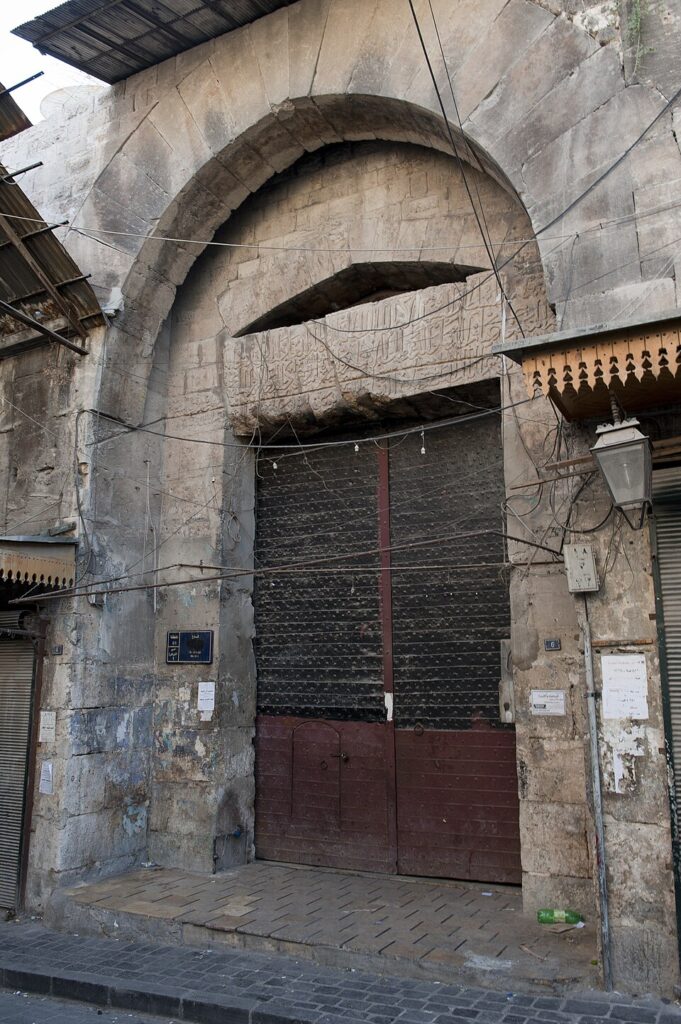
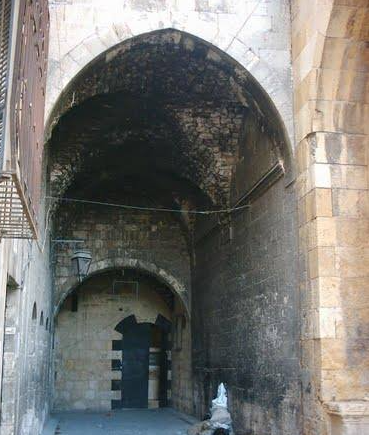
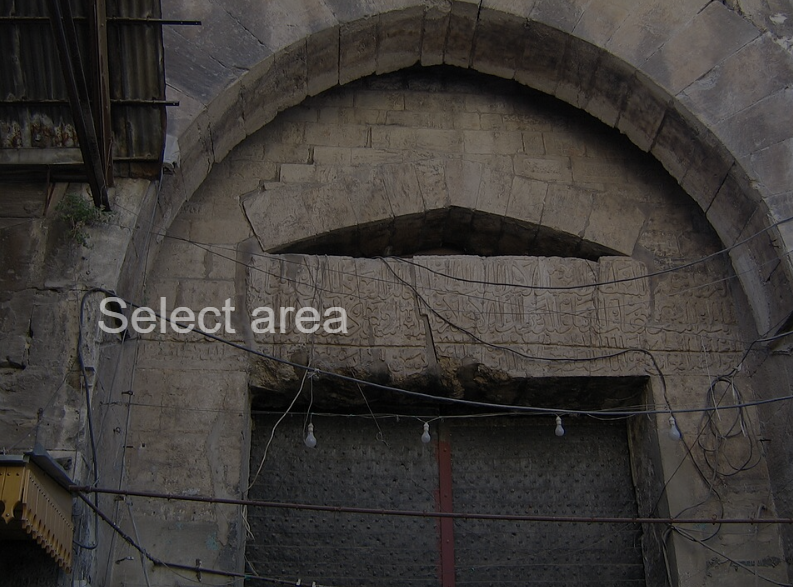
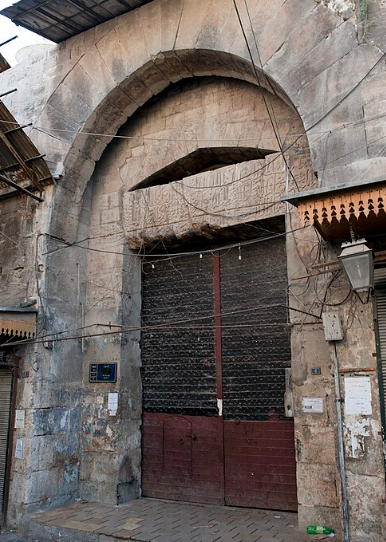
It was named Bab al-Yahud (the Gate of the Jews) because Jewish shops were located inside while their graves were outside. It was later called Bab al-Nasr (the Gate of Victory) when King al-Zahir Ghazi renovated it in 1212 AD / 609 AH, in the 13th century. It is currently known only as Bab al-Nasr. It originally had two gates leading to the outskirts of the city, which he demolished and replaced with four gates, along with high, well-built towers. From this gate, one exits onto the trench bridge. On its outskirts, there were high mounds of dirt and ash, which he removed, leveling the ground. He also built inns where grain and firewood were sold.
Ibn al-Hanbali of Aleppo also mentioned it, stating: In the year 610 AH, King al-Zahir Ghazi completed the construction of Bab al-Yahud in Aleppo. He had begun demolishing it, digging a trench, and expanding it. He reconstructed it beautifully, altering its original form. He built two large towers over it and named it Bab al-Nasr.
There were six inns outside the gate. This Jewish market intersected with the city’s central axis, which did not lead directly to the Great Mosque but deviated slightly eastward via the Soap Market and the market of the old neighborhood known as Hayy al-Balat (al-Balat neighborhood), which retained its name until the 16th century in the Khanqah of al-Balat. Here, the gate is considered a point of connection rather than a barrier, unlike Bab al-Hadid, which closed off the eastern suburbs.
The large Christian population in these northern suburbs, sometimes enclosed in certain neighborhoods and mixed with Muslims in others, was connected to the Ancient City within the walls by this gate, linking its economic activities, commercial enterprises, industrial operations, and civic character. Unlike the eastern suburbs, this area’s distinct Christian faith was prominently reflected.
In the Bab al-Nasr area, four continuous axes run parallel to the wall, serving broad neighborhoods to the west, leading to Bab al-Faraj and Bab Janin, as well as to the east and south. A dense and complex network borders small residential clusters, with many rooms opening directly onto wide, open streets. It is difficult to determine whether this network is ancient or to which era it belongs. Its openness does not indicate modern construction or state-designed planning from the 19th century.
Bab al-Nasr has been a hub of activity and traffic since the last century of Mamluk rule in Aleppo. It contains baths, mosques, and a high population density on its outskirts. Its main section was demolished when Khandaq Street was opened in the late Ottoman era in 1303 AH / 1885 AD, but its two defensive towers still stand.
An inscription on the ceiling of the gate states that it was built by order of King al-Zahir Ghazi in 609 AH. It was also the home of Minister Nizam al-Din al-Tughrai.